Quasiparticle burst recovery in a gap-engineered transmon
Yale measured what happens in the milliseconds after a high-energy impact hits a gap-engineered transmon. The qubit recovers in ~0.7 ms; the chip stays warm for longer. Our notes on the paper, and why it matters for cryostat wiring.
We make a component, an IR-blocking filter, and the interesting science happens in the labs that use it. This is the first in a series of reading notes on published results that say something concrete about the radiation environment inside a dilution refrigerator. First up: a 2025 Yale study that watches a quasiparticle burst hit a transmon, and times the recovery.
What the paper does
When a high-energy particle strikes the chip, it ionizes the substrate. The recombining electron-hole pairs release phonons energetic enough to break Cooper pairs in the superconducting film, and the resulting quasiparticles tunnel across the qubit junction: relaxation errors, correlated in time. The Yale team stabilizes the qubit in its excited state, reads it out every 5.7 microseconds for hours, and tallies relaxation events in 1 ms windows. Bursts stand out as clear departures from Poisson statistics.
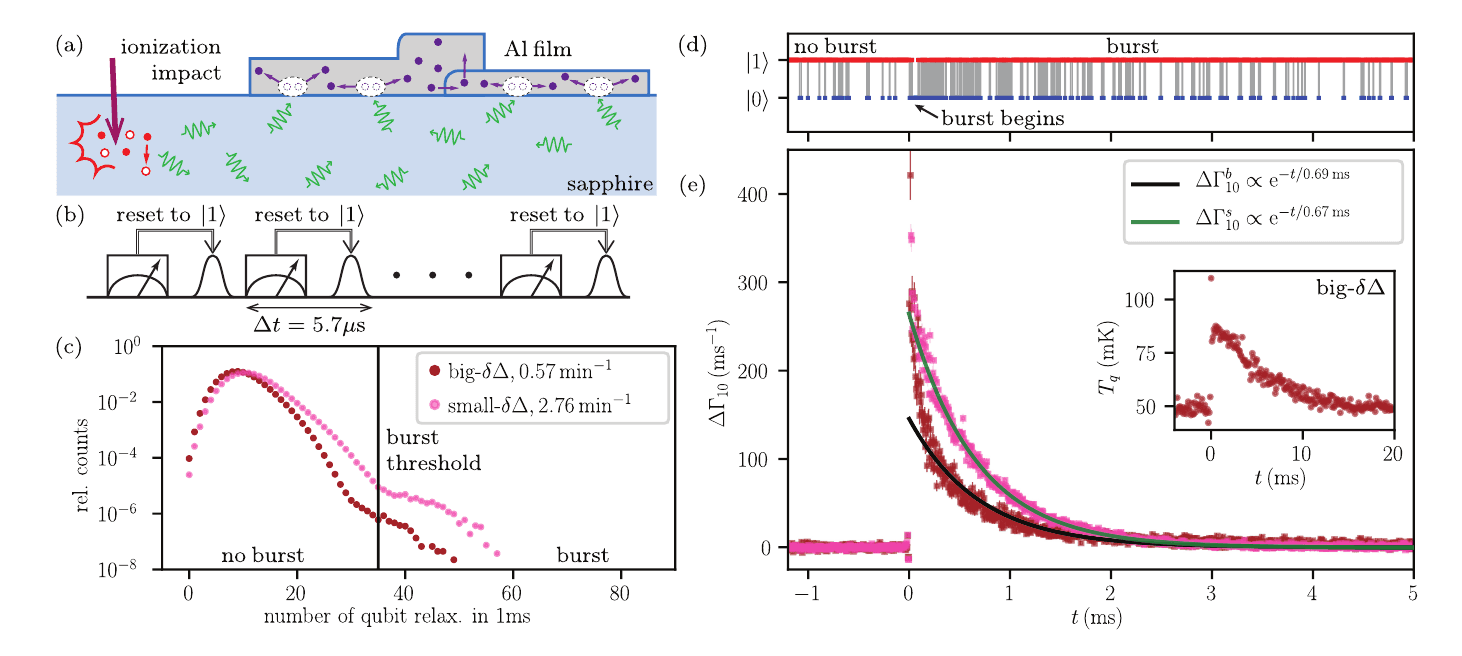
How a high-energy impact becomes a quasiparticle burst, and what recovery looks like: the excess relaxation rate decays with a ~0.7 ms time constant, while the qubit temperature jumps from 50 mK to roughly 90 mK and stays elevated for over 5 ms.
Fig. 2, “Recovery dynamics of a gap-engineered transmon after a quasiparticle burst” (arXiv:2505.08104), CC BY 4.0. Cropped from the original.
What gap engineering buys, and what it does not
Gap engineering, making one junction lead a thicker film with a lower superconducting gap, is the chip-level defence: the gap difference blocks resident quasiparticles from tunneling. It works, but the suppression of burst detection rates is about a factor of five, far less than the four orders of magnitude one would expect if the burst quasiparticles simply thermalized. The reason is in the recovery data: during a burst the substrate heats, and hot quasiparticles have enough energy to climb over the engineered gap. Recovery of the relaxation rate takes ~0.7 ms regardless of the gap difference, and the chip stays warm for milliseconds.
The A/B test we always get asked about
The supplementary material contains a comparison we get asked about often. The team benchmarked parity-switching rates, a direct proxy for quasiparticle tunneling, across shield and filter combinations: taped versus indium-sealed enclosures, home-made Eccosorb CR-110 and CR-112 filters of different lengths, a commercial XMA absorptive filter, and HERD filters with and without thermal anchoring.
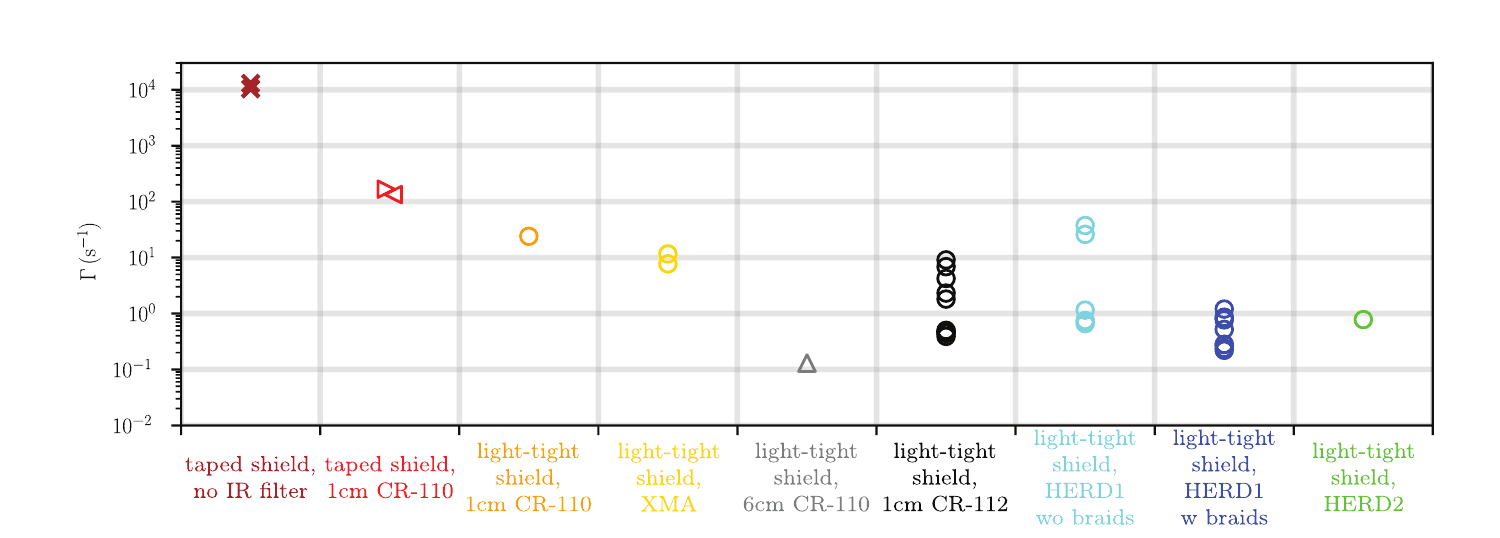
Parity-switching rate per protection configuration. Two things stand out: sealing the shield with indium is worth orders of magnitude on its own, and once the enclosure is light-tight, HERD filters sit at rates around and below one per second, in the same territory as several centimetres of Eccosorb.
Fig. S2, same paper (arXiv:2505.08104), CC BY 4.0. Cropped from the original.
Three practical notes from the data. First, light-tightness comes first: the same 1 cm CR-110 filter improves by an order of magnitude when the shield goes from taped to indium-sealed. Second, thermal anchoring matters: HERD-1 thermalized to the base plate with copper braids performs visibly better than without. Third, the part the plot does not show: absorptive filters buy their IR rejection with in-band insertion loss that grows with length and frequency, and on the readout line every dB before the first amplifier costs measurement efficiency, and with it readout signal-to-noise. HERD reaches the same quasiparticle floor at less than 0.15 dB in band.
Why we keep coming back to this paper
Because it separates the two jobs cleanly. Gap engineering handles quasiparticles that are already in the film. It cannot stop energy from arriving. Whatever reaches the cold stage, through the chip or along the coax, ends up as phonons, heat, and tunneling events. That is the case for a system-level defence in the wiring: keep Cooper-pair-breaking radiation (above roughly 80 GHz for aluminium) from entering in the first place. It is the job HERD filters are built for: more than 60 dB of attenuation above 70 GHz, with less than 0.15 dB in the signal band.
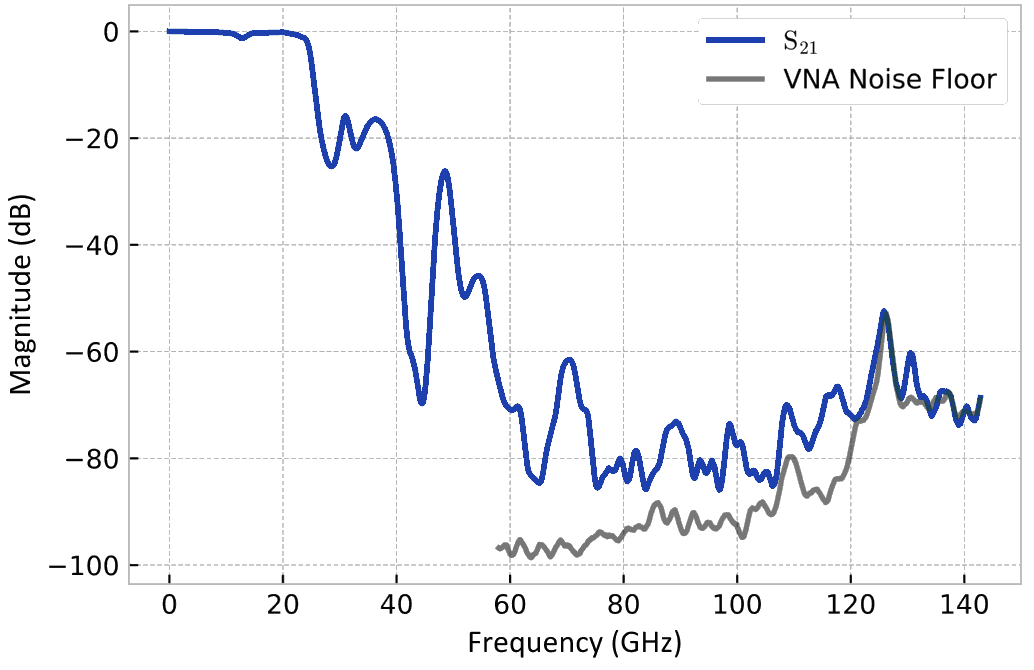
The wiring-side defence in one measurement: HERD-2 transmission from DC to 145 GHz. Flat in the passband, at the VNA noise floor above 70 GHz.
Sweden Quantum, HERD-2 datasheet.
Our takeaway
None of these results are ours; that is rather the point. Bursts will keep happening, and recovery physics sets how much they cost. The practical question for an experimentalist is how much energy reaches the cold stage at all, and that is set by shielding, light-tightness, and filtering working together. If your lab has measurements involving HERD filters you are willing to share, we would genuinely like to read them.
Measurements involving HERD filters? info@swedenquantum.com
Research library