
Passive filters.
Measurable gains.
HERD is a patented infrared-blocking filter for superconducting quantum processors. It removes high-energy radiation that breaks Cooper pairs while leaving your microwave signals essentially untouched, improving qubit coherence and readout without redesigning your stack.
Break the IR trade-off
HERD filters provide more than 60 dB attenuation above typical Cooper-pair breaking frequencies while keeping in-band insertion loss below a few tenths of a decibel. You no longer have to choose between low-insertion loss and high-frequency absorption.
Protect coherence and readout
By draining high-energy radiation before it reaches the qubit chip, HERD reduces quasiparticle-inducing noise that limits coherence. Experiments using HERD-2 report sub-Hz quasiparticle tunneling rates, state-of-the-art coherence and QND readout fidelities around 99.93% in superconducting circuits.
Built for cryostats
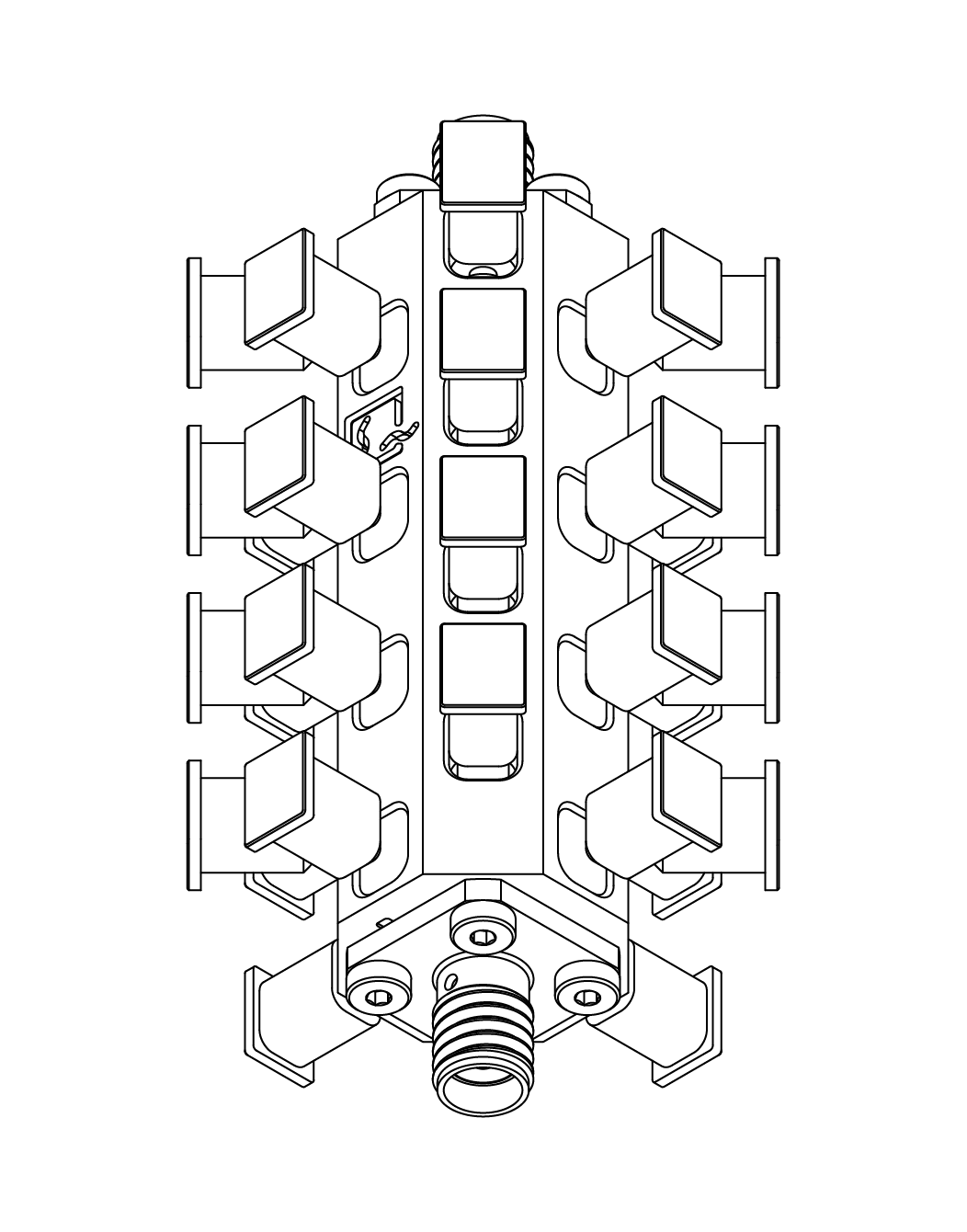
HERD-2 is a compact, non-magnetic, SMA inline component designed for high-density cryostats. Performance is validated up to 145 GHz and has exceptionally low unit-to-unit performance variation and reliable cool-down behavior.
Validation from the field
HERD filters are used in state-of-the-art experiments on superconducting qubits, including work on quasiparticle tunneling, coherence and high-fidelity readout.
Questions
Find answers to common questions about HERD and how it works.
Start with readout and drive lines where you care most about coherence, QND fidelity, and minimizing loss between the qubit and first amplifier stage. HERD is particularly valuable on lines where conventional absorptive IR filters would add unacceptable in-band loss or dispersion.
Absorptive filters (Eccosorb, copper-powder) provide strong IR attenuation but always introduce in-band loss and dispersion. LC / resonant filters are flatter in-band but leak at very high frequencies and often have parasitic paths. HERD is designed to combine the good parts of both: near-ideal low-loss transmission in the qubit band with stop-band attenuation exceeding 60 dB at high frequencies, and no obvious parasitic leakage paths.
Most partners place HERD at or near the mixing-chamber stage, often as close to the sample package as mechanical constraints allow. Some setups also use HERD at higher stages as part of a multi-stage shielding strategy. The optimal choice depends on your attenuator distribution and shielding; we can review this together before shipment.
HERD hardware uses carefully selected non-magnetic materials and platings, with repeated thermal cycling and cryogenic tests as part of the qualification process. Unit-to-unit variations are controlled in production, which is not the case for many “home-built” absorptive filters.